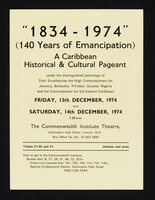
The show programme included a series of events featuring music, dance and drama to explore issues around black liberation 'from unsophisticated bondage to a sophisticated one'.
This was a 'historical & cultural pageant' presented by the West Indian Students Centre Folk Group exploring the experience of slavery in the West Indies through songs, poetry and mime.
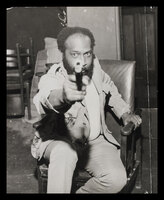
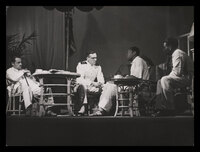
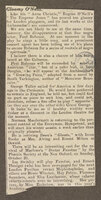
Starring Thomas Baptiste in the role of Jones, the performance was set on a West Indian island where, to quote the programme 'the form of native government is, for the time being, an Empire.' The play was inspired by the true story of President Sam of Haiti (who was rejected by the population after six months of despotic government) and by the author's interest in the use of the drum in African religious festivals.
The Slave is a 'ritual drama' in the form of a fable in which a debate takes place around the heritage of slavery and the hatred it generates. Its central character, Walker is an African American man who is leading 'a violent murderous black rebellion'. During the prologue he is dressed as an old field slave, and at the end of the play, as the city explodes, he is enslaved again, this time by mutual hatred with the society and people around him.
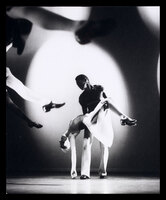
The show, presented by the London Contemporary Dance Theatre, explored the relationship between a Black man and a White woman in the American South of the 1950s, where memories of slavery impinged heavily on the couple and eventually led to the girl's death.
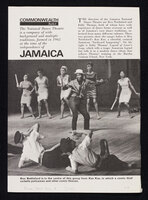
This is one of the choreographies created for the company by its choreographer Eddy Thomas and is based on a tragic Jamaican legend which tells the story of Liza, a house slave, and Ako, a slave boy who fell in love with her against the desire of her master. The performance used a contemporary dance idiom which reflected the choreographer's training at the Martha Graham school in New York.
Set in a West Indian Island, the play focuses on a strike by native sugar workers against the white plantation owner. The description of the conditions of work on the island takes a radical political stance in the representation of black and white people united in their fight against the owner. The play resonates with the political turbulence that swept across the Caribbean islands in the late 1930s and featured the black British actor Robert Adams as the trade union leader O’Riley. In 1944, Adams formed the Negro Repertory Theatre, one of the first professional black British theatre company.
The play is a classic study of the black revolutionary leader Toussaint L’Ouverture, who in 1791 led the Haitian revolution, which was triggered by the French Revolution and became the only truly successful slave revolt in history. The play also offers an uncompromising perspective on the ending of the British slave trade, radically challenging the humanitarian bias found in many accounts by looking at abolition within the wider historical process of capitalism. The production starred Paul Robeson in the role of Toussaint.
The play is set on a West Indian island ruled by the Emperor Brutus Jones and traces his journey back to Africa after the rebellion of his subjects. Lost in the forest, the Emperor is faced by nightmares from his personal and collective history, including a slave auction. The production, which starred Paul Robeson in the main role, was characterised by the incessant sound of drums, played during the scenes and over the interval.
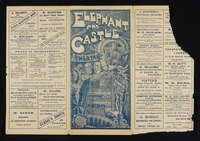
The play is another adaptation for the stage of Harriet Beecher Stowe's novella which testifies to the interest in the story and its place in the popular imagination well after the abolition of slavery in 1833.
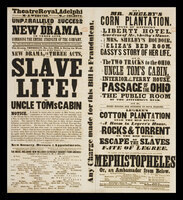
The play is a dramatic adaptation of Harriet Beecher Stowe’s novel, which came out in numerous editions and proliferated on the stage, attesting to its tremendous impact in 'the cause of slave liberation' in Britain. Interestingly the newspapers at the time reported a groundswell of discussion generated by the novel regarding the condition of slavery in America and the related questions of emancipation.