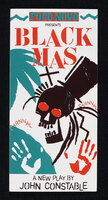
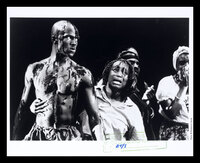
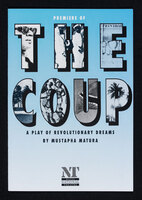
The play takes place in a hotel in Trinidad during Carnival. Roy, the hotel keeper chooses to masquerade as Anancy whilst his wealthy white friend, Marduke, masquerades as Death. The characters are taken from the African legend of 'Anancy Tricking Death', which was brought to Trinidad by enslaved Africans.
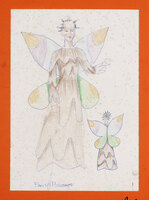
A folk/rock-fairytale Christmas musical, it takes place, to quote the programme, ‘in and around Strawberry Palace in Strawberry Land in the Land of Fantasia' and then 'the Mongoose Territory and the Land of the Serpentine'. The story centres on Anansi, 'the National folk-hero of Jamaica', who is part-spider, part-man. The Anansi stories form an integral part of Jamaica's cultural heritage around which the genre of Jamaican pantomime was built. This was the second Anansi pantomime that the Dark and Light Theatre Company produced.
Translated as The Kind Does Not Hang, this was a Yoruba Folk Opera retelling of the story of King Sango and his two rival generals. The performance represented an example of Total Theatre, interweaving music, acting, dancing and visual arts and the use of traditional drums including the Dundun (Talking Drum), played in contrast with the metallic tone of the Bata.
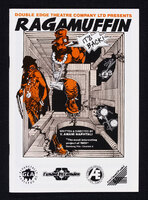
The play juxtaposes historical events from the 1791 Haitian Revolution with the 1985 Broadwater Farm riots in London. The story is told through its central character, Ragamuffin, the warrior, fusing dancehall, reggae and rap style music and choreography. The play is set in a ceremonial court where Ragamuffin is on trial for ‘gross misconduct' and waits for a verdict from the jury played by the audience.
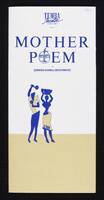
The play, adapted by the company, is described in the programme as 'a meditation (…) a combination of dreams, memories and questions' inspired by the island of Barbados, the idea of belonging and the effects of slavery in the relationships between women, men and children. As a poem, the play text makes use of strong visual images for the narration of the journey back home of three black British women and the ways in which they relate to their personal and collective past.
This play focuses on the repercussions following the brutal killing of 130 slaves thrown into the sea from the slave ship Zong. The show, produced as part of the celebrations for 2007 Black History Month, included a choral mix of evocative songs from West Africa, the Caribbean and Southern USA.
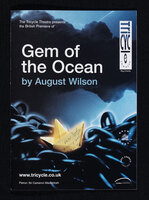
Described by the author as the journey of Black Americans 'from property to people', the play traces the story of Black Americans at the turn of the last century, in the Hill district of Pittsburg, coming to terms with the economic legacy and memories of African slavery.
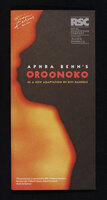
Drawing on Yoruba culture, this version of Aphra Behn’s 1688 novella reinstates the African scenes that were cut in previous drama adaptations and presents for the first time on stage the character, Imoinda, as a Black African.
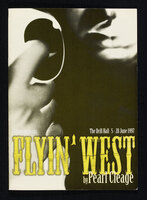
The play explores the condition of Black people in the United States after slavery was abolished in 1865. It is based on the Jim Crow laws, a nineteenth-century version of apartheid, which imposed the separation of the races in the Southern states of America, affecting everyday Black-White relations in all aspects of life.
This production explored issues around multiple identities for people with multiple heritages and in particular the social and economic implications for mixed-raced children in Britain. The shadows of African slavery were explored through movement and songs in this piece of groundbreaking physical theatre.
The play spotlights Afro-Brazilian culture by reconstructing the true story of Zumbi, an African slave living in Brazil, who was killed by the Portuguese in 1695 for defending his village. The story takes place in modern times to expose the unchanged conditions of life of Black people internationally, and interweaves the tale of the original rebellion with a series of narrative strands that take place in Nigeria, Ghana, Jamaica and Britain.
This ;play of revolutionary dreams' was inspired by an attempted coup against Eric Williams, the first prime minister of Trinidad and Tobago, and explores issues of post-independence power.