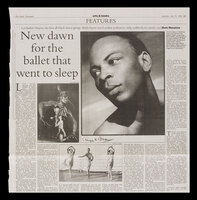
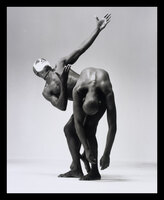
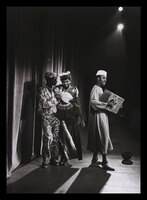
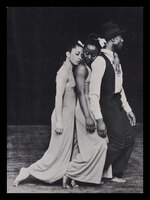
This was a tribute by black-dance awareness group, Positive Steps, to honour the groundbreaking choreographers Berto Pasuka and Richie Riley, founders of Les Ballets Nègres dance company. During the 1940s and 1950s their seminal work revitalised the dance scene with innovative interpretations of Caribbean and African art forms and their 'Africanist' aesthetic practices.
This dance piece was inspired by a creation legend from the Bushongo, a Bantu tribe in Central Africa, whose creator, Bumba, is said to have experienced a searing pain in his belly and vomited up the sun, moon and stars into an empty space.
The show, which focused on the story of Bala Fassake and the way he made his way into the Mandingo Empire, was presented by the dance company, Les Ballets Africains, including 34 dancers and musicians, based in the Republic of Guinea.
The production presented a series of dance pieces covering 30 years of the company's productions, and included the ground-breaking 1960 choreography piece, Revelations.
This dance piece told the story of Aryee, the son of an African chief, who had to be re-educated about the dances of his tribe after a long period in the West. The chief sent him on a journey of discovery across the continent to learn anew the significance of dance in Africa.
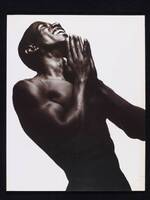
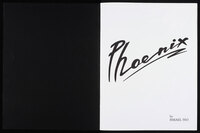
This choreography by the renowned soloist dancer from Brazil, Ismael Ivo, investigates the role played by the historical past and personal memories in shaping the present. As noted in the programme, 'contradictions attract me. They are a challenge to look for a synthesis in my artistic work…This is the first contact with the history of my roots, with the origins of African Diaspora. It was the beginning of my reflections about life, death, rebirth and eternity.'
The show displayed traditional dances performed in different regions in Ghana and was presented as a 'revival of ceremonial dances which were performed by forefathers' (see programme). Dance pieces included Dagbani, presenting varied rituals from Northern Ghana commemorating the birth of the Prophet Mohammed, and dances from Dahomey representing war scenes.
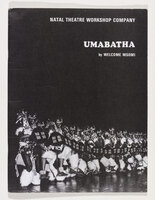
This was a Zulu adaptation of the story of Macbeth, set in Mfolozi, Zululand. Mirroring the tribal experience of the Zulu people, the show presented no rigid distinctions between drama, music and dance and told the story of Mabatha and his struggle for power with the chief of the Magebas tribe and his sons. The production used the form of so-called ’imitative’ dance practised by Zulu people for the re-creation of significant events or the celebration of valued achievements.
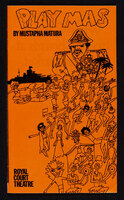
A comedy set in Port of Spain, Trinidad, it features the annual carnival festivity as a central setting for showing inter-racial tensions on the island. The connection between power and masquerade was conveyed through the use of traditional characters and costumes, which were designed for this production by leading Trinidadian Carnival artist Peter Minshall.