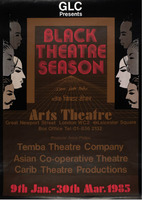
Following conversations with the director of Nitro Theatre company, formerly known as Black Theatre Co-op, Future Histories agreed to include the company's archive in its project activities to preserve and share the history of Black performing arts through cataloguing, exhibitions, and creative interpretation. The company promoted itself as a Black Performance and Carnival Archive.
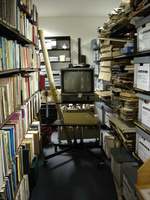
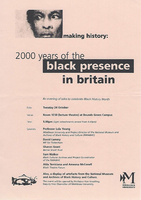
With the support of Professor Lola Young, in 2001 Future Histories began setting up an archive space at Middlesex University Bounds Green Campus to house and preserve black theatre archives with the view of creating a research centre on black British performing arts. The lecturer Ruth Thompsett, also a member of the Future Histories board, expressed her interest in including her Carnival archive material in the activities.
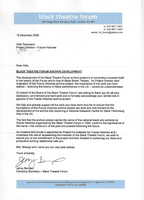
Future Histories was officially incorporated on 12 July 2001 by Terracciano and McConnell, respectively Chair and Company Secretary. They were joined on the Board of Directors by black artists, professionals and supporters, including Errol Lloyd and Jenny Bernard still active to this day. The Black Theatre Forum archive was eventually donated to Future Histories.
In the early 2000s Terracciano and McConnell negotiated the move of the Black Theatre Forum archive to Middlesex University for preservation and public access. They saw the benefits of setting up an independent organisation to manage the collection, which McConnell suggested could be named after the Forum's seminal conference.
As part of her PhD research on the history of black theatre in Britain, Alda Terracciano engaged with the archive and collected material on the Black Theatre Seasons. To prevent the loss of the dispersed archive, she devised a project to re-assemble and catalogue it, collaborating with the Theatre Museum Curator at the V&A to submit a funding application to the Clore Foundation, which was unsuccessful
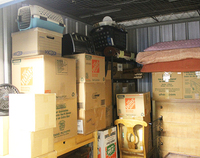
Jeremy Conlon, Ameena M. McConnell, Mel Jennings, John Shevon, Jenny Bernard, and Shabaka Thompson at the Yaa Asantewa Centre offered to privately host the Forums' archive, which was boxed up and housed in different storage places in London. In those circumstances it was not possible to retain the original structure of the archive.
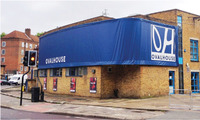
When the Arts Council England stopped funding the Black Theatre Forum, its Board of Directors was forced to close the office at Oval House and split the archive.
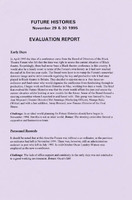
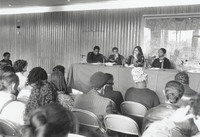
In 1995 the Black Theatre Forum organised the Future Histories conference at the South Bank Centre in London, which attracted over 200 delegates, to discuss the future of black theatre in the UK and the preservation of its heritage.
The Black Theatre Forum was formed in 1985 as an umbrella organisation of seventeen African, Caribbean, and Asian theatre companies to stimulate the development of black theatre in Britain and promote greater equality and more opportunities for black theatre professionals.
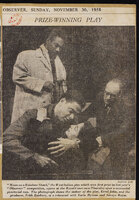
Set in Trinidad, where Errol John came from, the play focuses on the story of two lovers, Ephraim and Rose. It explores Ephraim's attempts to break away from the island and move to London to seek his fortune. The play won the Observer playwriting competition the previous year and represented a breakthrough when performed at the Royal Court because of its pioneering use of Creole.
As noted in the programme, the plays explores 'the struggle for self-determination in a hostile colonial environment'. Its central character, Glory is symbolic of the political and cultural conflicts in a colonial society and the effects that a history of enslavement has on the human psyche in the struggle for self-realisation and true freedom. The production used ritual as a form of non-verbal theatrical expression, and the mask as 'a vehicle for immediate meaning used to conceal and reveal character'.
The play, which was presented by the Ugandan Abafumi Company from Kampala, explores the links between authentic local theatre roots, religious ritual and court entertainment. The company used four languages (Luganda, Acholi, Rounyankole and Rounyarwanda) during the course of the performance, juxtaposed with non-verbal elements such as dancing, drumming and religious ritual.